why you should start journaling (and how!)

Journaling is amazing. It gets a bad rap because people think introspection is vain, frivolous, or that it takes more time than it’s worth.

I’d like to step in and not only defend journaling, but advocate for it!

A few years ago I was going through a rough time in my life. I was surviving day-to-day, but when I attempted to look back at my week it was all a blur. I decided to start writing a little bit each day to simply document what I did and my high-level thoughts. And I never stopped.

I love having a chronicle of my days. I don’t write every single day, but I try to. Even if it’s just a couple of sentences, it’s nice to check in with myself regularly.

This image has an empty alt attribute; its file name is jessica-delp-nuqtviftqs4-unsplash.jpg

benefits of journaling

This list could go on (and on, and on), but here are my top four:

Processing and reflecting: thinking about moving to a new city? Working through a loss? As we cogitate on impending change, it’s helpful to write about it. It might seem intimidating at first, but all you have to do is start writing. Describe the event or change as you would to a friend. Think about your most heightened emotion in this moment and attempt to describe it. Take your best guess as to why you feel that way. There’s no right or wrong, and you’ll find that this simple formula will be easier than you think. Your entry may be as simple as, “today my best friend announced he’s moving to Antartica. I feel kind of scared for him since it’s so cold, but also jealous because I’ve never left my home state. Maybe I should plan a visit once he gets settled.” Boom. Easy as that!

Venting: when you’re going through something (a fight with your partner, trouble at work, drama with a friend, etc.) you don’t always have someone you can vent freely to. That’s where journaling comes in! When I’m overwhelmed or keyed up at work, I will take a walk and journal (via my journaling app). It lets me vent without judgement, and after I finish ranting about how unfair something is or how angry someone made me, I genuinely feel better. Like I’ve gotten all of my thoughts down on paper, so my brain can stop reeling. After journaling, I can let go of my immediate feelings and get back to work becuase I know my thoughts are captured, and I can revisit them on my drive home.

Remembering: have you ever gone on an amazing vacation only to forget all but the highlights a few years later? Did you stand up in a friend’s wedding but barely remember how the day went? I try to journal each day during vacation or the day after a large life event. I’m telling you, this is one of the best things I’ve started doing! I can look back on any trip I’ve been on in the last fews years and read a bullet list of everything I did each day, as well as who I was with and how it went. It’s really fun to look back and relive the best (and craziest) parts of a trip or major life event. Future you will be so thankful!

Checking for patterns and understanding what matters to you: the more you write, the more you have to look back on. One of the great benefits of journaling is that you can look back and assess patterns. When you’re able to write about anything, what do you write about? Do you tend to mention your dream of obtaining a new certification at work? Or how you’re worried about your dad feeling lonely? The new person you’ve been dating? When you free write often, you unleash your mind and allow yourself to fixate on whatever is most interesting or appealing in the moment. If you find you’re writing about the same thing, that might be a clue into what’s most important.

styles of journaling

Are you considering starting a journal becuase I sold you on all of the amazing benefits? If you’re interested in starting to journal, take stock of all of the different types of journaling and select the one(s) that sound fun or intriguing to you. You can do all of these, one of them, or find your own unique style.
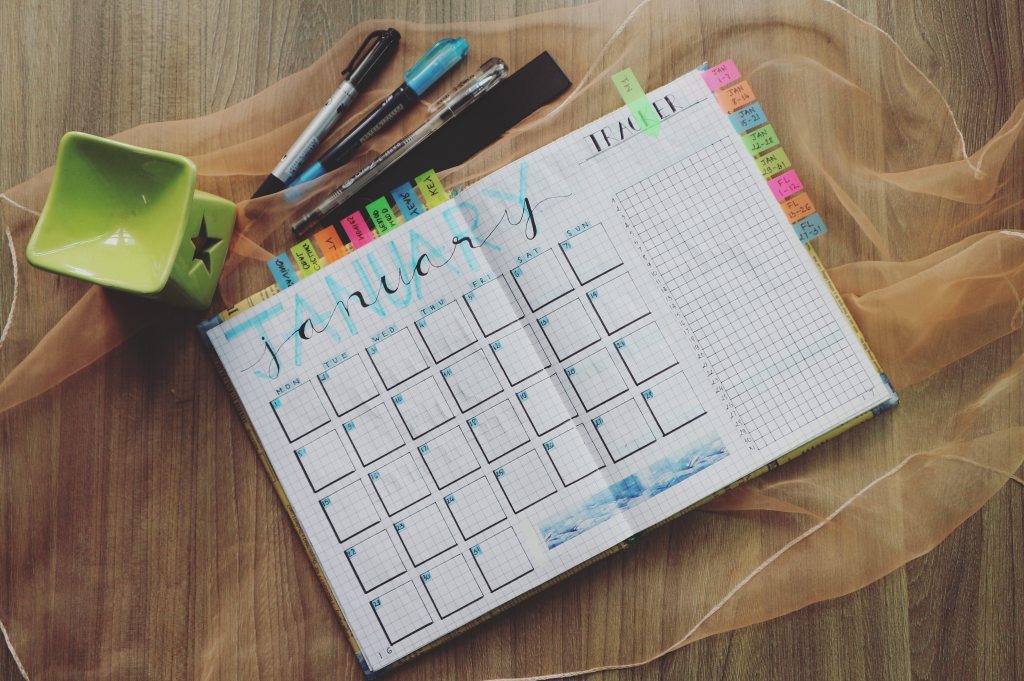
bullet journal: a bullet journal is non-intimidating catch all. You can use it to track to-do lists, remind yourself of appointments, track towards goals, and more. Bullet journals get their name in part from the dot grid style of the pages as well as the bullet-list style of your entries. The idea is not to write long paragraphs of text, but to list out your goals, your worries, your accomplishments, etc. Try this classy and simple journal or this small but beautiful set.

scrapbook journaling: I would call scrapbook journaling a combination of bullet journaling and scrapbooking. The idea is that you’d tape/glue items to the pages of your journal like concert tickets, dinner receipts, movie tickets, photos, invitations, fortune cookie fortunes, etc. Then you would write about the item and its associated event, people, places. This is a method of journaling I used to love becuase the object takes up a lot of space on your journal pages meaning you don’t have to write a ton. It’s also a really cool thing to have and look back on. I’d recommend a blank journal without lines and a spiral bind to allow for the expansion of the pages once you begin adding items. Check out this simple option.

prompt journaling: this is a great option if you’ve never tried journaling or if you’re worried you won’t know what to write about. You can purchase a journal with built-in prompts like “what was your favorite childhood toy?” or “describe the perfect movie-going experience.” Though maybe a tad trite, these prompts will get you thinking, remembering, reflecting, and most importantly, writing. You can select journals like this one that focus on autobiographical prompts, or like this one that’s intended to help you reflect and focus each day. If you already have a journal in mind or want to use a blank journal, you also have the option to download an app that generates prompts like Paperblanks Journal Prompts.
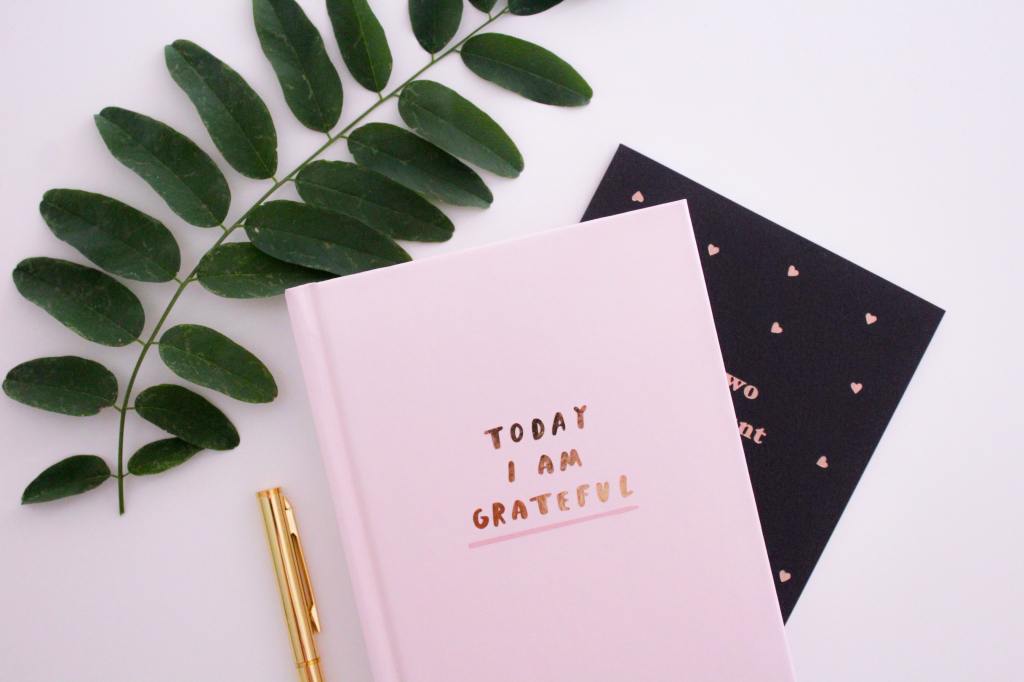
gratitude journaling: one of my favorite quotes I’ve ever heard:

“If we all threw our problems in a pile and saw everyone else’s, we’d grab ours back.”

― Regina Brett

Chances are you have a number of things in your life that you’re grateful for. If you’re interested in working on mindfulness and perspective, consider writing about the things in your life you’re thankful for. This could be as simple as making a list each day of everything you’re thankful for, or you could choose something you’re thankful for an write a bit exploring that. Your entry might start like this, “I’m super thankful to have a reliable car. My sister’s car needed to be jumped this morning, and on her way home from work her brakes started giving out. My car is reliable, and I am thankful I don’t have to worry about it starting each day. Sometimes I beat myself up for spending more on it than I should have, but times like this make me realize that a few extra dollars have given me a lot of peace of mind.”

You can use challenge yourself to come up with something new each time your write, or you could invest in a journal with prompts specifically for people who want to reflect on the good in life. This one is infused with thought-starters and quotes, but won’t be overwhelming if you find endless blank pages intimidating. I went for a less traditional (and slightly more vulgar) version with this one. Of course, there are options like this one that are much more free-form, or you could use any plain journal you want.
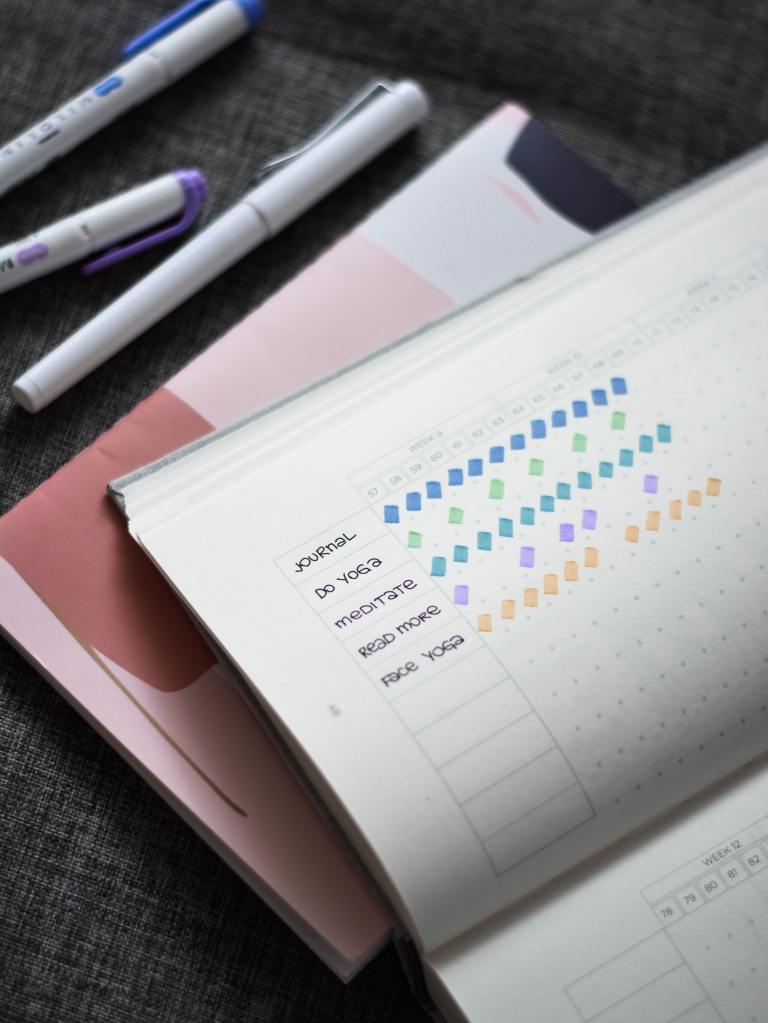
habit journaling: this is journaling with an end goal in mind. Maybe you want to drink more water, quit smoking, cut down on carbs, eliminate added sugar for a while, learn a new language, teach yourself to draw, etc. A habit journal might be the tool for you! You may have heard that it takes 21 days to build a new habit, but Gretchen Rubin of The Happiness Project notes that “according to a recent study, a daily action like eating fruit at lunch or running for 15 minutes took an average of 66 days to become as much of a habit as it would ever become.”

The best way to track your new habit is with a journal! You could nest this type of journaling in any of the other journal types listed, or you can choose to have a dedicated habit journal like this one or this one.

traditional journaling: journaling is it’s simplest form! This has proven to be my favorite type of journaling to do. I like the limitlessness of having blank pages to fill how and when I want to. When I started keeping a journal there was a lot going on in my life, so I wanted a judgement-free space to get my thoughts out and examine them. I opted for a small, blank journal with a fun cover (like this one or this one). Some times I would write every day for a week and sometimes I’d write three times total each month. I love being able to look back at my thoughts, activities, and analyses all these years later. In a lot of ways my old journals are time capsules from a different time, and I love being able to look back on them.

paper versus app

The two main options are paper journals or a journaling app. Let’s look at the pros and cons for each.

paper journaling

pros

  • productive: it’s so much easier to focus on a blank sheet of paper without phone notifications interrupting you
  • less screen time: staring at the pages of your paper journal is much easier on your eyes than staring at a screen while you write
  • safer: you don’t have to worry about someone hacking into your journal. But you might have to worry about any housemates, children, or significant others taking a peak

cons

  • harder to bring with you: it’s much easier to journal in line at the bank when you’re on your phone, but it’s much harder to do so with a journal you have to carry with you
  • vulnerable: with a paper journal, I always worried about spilling on it, losing it in a fire, forgetting it somewhere, etc. With a phone app I don’t have to fret over those things

journaling on your phone

pros

  • convenience: you probably take your phone with you everywhere, so it’s super convenient to have your journal at your fingertips whenever you have a spare moment
  • patterns and analytics: some journal apps allow you to review basic trends in your writing such as your mood during certain days or times of day, the days you prefer to write, and much more
  • multi-tool ability: some apps let you make entries on your phone, tablet, and laptop

cons

  • security: with anything stored on a cloud, you’re running the (relatively small) risk of a data breach
  • more screen time: this is a con in my book as I try to have as little screen time as possible

Final thoughts on paper vs apps: personally, the pros of the app outweigh the pros of keeping paper journals, however I’m glad I started with paper journals. Something feels really good about physically writing in an age where we write less and type more.

final tips

Try it out! There’s no shame in giving it a try. Attempt to write at least one thing each day for a month. Don’t stress if you miss a day or two and don’t think you have to fill a page. Even a couple of sentences will reinforce the positive impact journaling can have.

Start small. Choose a journal that’s smaller in size. A smaller canvas feels less intimidating since you don’t have to stress about filling up a huge blank space.

Don’t let it become a chore. This is so important. You’re not journaling for nothing, you’re hoping to get all of the awesome benefits that come with stopping, reflecting, and recording your life. If you miss a couple of days in a row, don’t worry! Sometimes I would write a single time in a month, and sometimes I’d write every day for weeks at a time. Usually I try to write at least once per week, but it varies based on what’s happening in my life.

Remind yourself of why you started. If you find yourself stressed about not having written in a while, remember the benefits of journaling and why you decided to start. It doesn’t mean you berate yourself, but remember what you get out of it will be so motivating.

Look back often. One of my favorite things to do is look back on what I wrote a year, two years, or even two weeks ago. It’s funny how easily you can step back into your mindset at the time of the entry. It’s fun to see what I was up to and how I was handling things. It motivates me to keep writing!

Pair journaling with another habit. Incorporate journaling into your other regular routines like waiting to pick kids up from practice, while coffee is brewing, right before bed, etc. The idea here is that you’re less likely to forget about journaling when you pair it with another activity you do regularly.

Purchase a journal you’ll want to use. This is huge. If you love your journal, you’ll want to spend more time with it. My first adult journal was pink with shiny gold pigs all over it. It always made me smile when I’d notice it on a shelf. Pick something that fits your style and excites you to write.


privacy policy

Last updated: August 6, 2020

OWNER AND DATA CONTROLLER

acceptably imperfect (“us”, “we”, or “our”) operates http://atomic-temporary-178072446.wpcomstaging.com (the “Site”).

Contact email: colettemarie@acceptablyimperfect.com

We are committed to protecting and respecting your privacy. This Site collects some personal data from its users.

This Privacy Policy informs you of our views, practices and policies regarding the collection, use and disclosure of personal data we receive from users of the Site.

By submitting personal data to us, you agree to us using your personal data as follows.

INFORMATION COLLECTION, BUSINESS PURPOSE AND USE

While using our Site, we may ask you to provide us with certain personally identifiable information that can be used to contact or identify you. Personally identifiable information may include, but is not limited to name, email address, cookies, usage data, password.

We may use your personal information to:

  • send you our newsletters from time to time
  • manage contacts and send messages
  • ensure that content from our site is presented in the most effective manner for you and for your computer
  • provide you with information, products or services that you request from us which may be of interest to you
  • carry out our obligations arising from any contracts entered into between you and us
  • interact with external social networks and platforms (e.g. social media widgets and share bars)
  • allow access to third party services’ accounts
  • monitor infrastructure
  • manage hosting and backend infrastructure
  • interact with live chat platforms
  • carry out remarketing and behavioral targeting (including display ads)
  • display content from external platforms
  • carry out commercial affiliation (e.g. display ads)
  • interact with support and feedback platforms
  • manage user database

We collect information that identifies, relates to, describes, references, is reasonably capable of being associated with, or could reasonably be linked, directly or indirectly, with a particular consumer, household, or device. Personal information does not include

  • Publicly available information from government records.
  • Deidentified or aggregated consumer information.
  • Information excluded from the CCPA’s  scope 

In particular, we have collected the following categories of personal information from our users within the last twelve (12) months: add this table then indicate YES or NO in the third column as applicable. This table has been pre-filled with the most likely scenarios for most websites for your convenience. 

­

ExamplesCollected
­­
A. IdentifiersA real name, alias, postal address, unique personal identifier, online identifier, Internet Protocol address, email address, account name, Social Security number, driver’s license number, passport number, or other similar identifiers.YES
B. Personal information categories listed in the California Customer Records statute (Cal. Civ. Code § 1798.80(e))A name, signature, Social Security number, physical characteristics or description, address, telephone number, passport number, driver’s license or state identification card number, insurance policy number, education, employment, employment history, bank account number, credit card number, debit card number, or any other financial information, medical information, or health insurance information. Some personal information included in this category may overlap with other categories.YES
C. Protected classification characteristics under California or federal lawAge (40 years or older), race, color, ancestry, national origin, citizenship, religion or creed, marital status, medical condition, physical or mental disability, sex (including gender, gender identity, gender expression, pregnancy or childbirth and related medical conditions), sexual orientation, veteran or military status, genetic information (including familial genetic information).NO
D. Commercial informationRecords of personal property, products or services purchased, obtained, or considered, or other purchasing or consuming histories or tendencies.YES
E. Biometric informationGenetic, physiological, behavioral, and biological characteristics, or activity patterns used to extract a template or other identifier or identifying information, such as, fingerprints, faceprints, and voiceprints, iris or retina scans, keystroke, gait, or other physical patterns, and sleep, health, or exercise data.NO
F. Internet or other similar network activityBrowsing history, search history, information on a consumer’s interaction with a website, application, or advertisement.YES
G. Geolocation dataPhysical location or movements.YES
H. Sensory dataAudio, electronic, visual, thermal, olfactory, or similar information.NO
I. Professional or employment- related informationCurrent or past job history or performance evaluations.NO
J. Non-public education information (per the Family Educational Rights and Privacy Act (20 U.S.C. Section 1232g, 34 C.F.R. Part 99))Education records directly related to a student maintained by an educational institution or party acting on its behalf, such as grades, transcripts, class lists, student schedules, student identification codes, student financial information, or student disciplinary records.NO

We obtain the categories of personal information listed above from the following categories of sources:

  • Directly from you. For example, from forms you submit or transactions related to products and services you purchase.
  • Indirectly from you. For example, from your browser while visiting our Site.
  • From third parties. For example, from our business partners or service providers.

We do not intentionally collect or use the personal information of minors under sixteen (16) years of age or sell it with or without affirmative authorization. 

In addition to the above, we may collect log data and use cookies.

Log Data

Like many site operators, we collect information that your browser sends whenever you visit our Site.

This Log Data may include information such as your computer’s Internet Protocol (“IP”) address, browser type, browser version, the pages of our Site that you visit, the time and date of your visit, the time spent on those pages and other statistics.

In addition, we may use third party services such as Google Analytics that collect, monitor and analyze this data.

Cookies

Cookies are text files with a small amount of data, which may include an anonymous unique identifier.

Cookies are sent to your browser from a web site and stored on your computer’s or tablet device’s or mobile device’s part of the hard drive specifically designated for cookies.

It is standard practice to use cookies to make your experience better when using a website.

Like many sites, we use “cookies” to recognize, collect, and/or track information about, and relevant to, your usage of the Site.

Please refer to our Cookie Policy for information on what cookies we use, for what purposes we use cookies, and how to control cookies.

Upon your first visit to the Site (and periodically after that), we will request your consent to our use of cookies, except for those strictly necessary.

DATA STORAGE

By submitting your personal data, you agree to this transfer, storing or processing. We will take all steps reasonably necessary to ensure that your data is treated securely and in accordance with this privacy policy.

LAWFUL BASIS OF PROCESSING PERSONAL DATA 

We may process personal data relating to users if one of the following applies:

  • users have given their consent for one or more specific purposes;
  • provision of data is necessary for the performance of an agreement with the user and/or for any pre-contractual obligations thereof;
  • processing is necessary for compliance with a legal obligation to which we are subject;
  • processing is related to a task that is carried out in the public interest or in the exercise of official authority vested in us;
  • processing is necessary for the purposes of the legitimate interests pursued by us or by a third party.

DATA RETENTION

We process and store your personal data for as long as required by the purpose they have been collected for.

Therefore:

  • personal data collected for purposes related to the performance of a contract between us and the user will be retained until such contract has been fully performed;
  • personal data collected for the purposes of our legitimate interests will be retained as long as needed to fulfill such purposes;
  • we may be allowed to retain personal data for a longer period whenever the user has given consent to such processing, as long as such consent is not withdrawn;
  • we may be obliged to retain personal data for a longer period whenever required to do so for the performance of a legal obligation or upon order of an authority.

Once the retention period expires, personal data will be deleted and some of your rights (i.e. the right to access, the right to erasure, the right to rectification and the right to data portability) cannot be enforced after expiration of the retention period. You may find specific information regarding your rights within the relevant section of this Privacy Policy or by contacting us at via our contact form

THIRD-PARTY DISCLOSURE

We do not sell, trade, or otherwise transfer to outside parties your personal information unless we provide users with advance notice. This does not include website hosting partners and other parties who assist us in operating our website, conducting our business, or serving our users (such as, for example, Gmail), so long as those parties agree to keep this information confidential. We may also release information when its release is appropriate to comply with the law, enforce our site policies, or protect ours or others’ rights, property or safety.

However, non-personally identifiable visitor information may be provided to other parties for marketing, advertising, or other uses.

In the preceding twelve (12) months, we have disclosed the following categories of personal information for a business purpose:

Category A: Identifiers

Category B: California Customer Records personal information categories

Category D: Commercial information.

Category F: Internet or other similar network activity.

Category G: Geolocation data. 

We disclose your personal information for a business purpose to the following categories of third parties: 

  • Professional service providers
  • Third parties whose services you purchase through our Site
  • Social media networks

YOUR RIGHTS

Users have the right to do the following:

  • Withdraw their consent at any time. Users have the right to withdraw consent where they have previously given their consent to the processing of their personal data.
  • Object to processing of their data. Users have the right to object to the processing of their data if the processing is carried out on a legal basis other than consent.
  • Access their data. Users have the right to learn if data is being processed by us, obtain disclosure regarding certain aspects of the processing and obtain a copy of the data undergoing processing.
  • Verify and seek rectification. Users have the right to verify the accuracy of their data and ask for it to be updated or corrected.
  • Restrict the processing of their data. Users have the right, under certain circumstances, to restrict the processing of their data. In this case, we will not process their data for any purpose other than storing it.
  • Have their personal data deleted or otherwise removed. Users have the right, under certain circumstances, to obtain the erasure of their data from us.
  • Receive their data and have it transferred to another controller. Users have the right to receive their data in a structured, commonly used and machine-readable format and, if technically feasible, to have it transmitted to another controller without any undue delay.
  • Lodge a complaint. Users have the right to bring a claim before their competent data protection supervisory authority.

You can exercise your right to prevent such processing by contacting us via our contact form.

These requests can be exercised free of charge and will be addressed by us as soon as possible and always within thirty (30) days.

YOUR RIGHTS UNDER THE CCPA

Users who reside in California have the right to request any of the following 

  • disclosure of the categories and specific pieces of personal information we have collected
  • deletion of personal information we have collected from you
  • disclosure of the categories of personal information we have collected, the categories of sources from which we collected it, the business or commercial purpose for collecting or selling it, the categories of third parties with whom we share it, and the specific pieces of personal information we have collected
  • disclosure of the categories of personal information we collected or sold and the categories of third parties to whom it was sold

You have the right not to receive discriminatory treatment for the exercise of these privacy rights.

Requests can be submitted by you or someone legally authorized to act on your behalf by email to colettemarie@acceptablyimperfect.com and via our web form.

These requests can be exercised free of charge and will be addressed by us as soon as possible and always within forty-five (45) days.

YOUR RIGHT TO OPT OUT OF THE SALE OF PERSONAL INFORMATION

Under the CCPA, “sell,” “selling,” “sale,” or “sold,” means selling, renting, releasing, disclosing, disseminating, making available, transferring, or otherwise communicating orally, in writing, or by electronic or other means, a consumer’s personal information by the business to another business or a third party for monetary or other valuable consideration.

As per the CCPA definition, selling personal information includes disclosing information to a third party by using analytics tools, running ads or having social media pixels and plugins installed.  

Users who reside in California have the right to opt out of the sale of personal information.

Requests to exercise your right to opt out can be submitted by you or someone legally authorized to act on your behalf by email to colettemarie@acceptablyimperfect.com and by following the link below and submitting your request via our web form.

NON DISCRIMINATION AND NOTICE OF FINANCIAL INCENTIVES

We will not discriminate against you for exercising any of your CCPA rights. Unless permitted by the CCPA, we will not:

  • Deny you goods or services.
  • Charge you different prices or rates for goods or services, including through granting discounts or other benefits, or imposing penalties.
  • Provide you a different level or quality of goods or services.
  • Suggest that you may receive a different price or rate for goods or services or a different level or quality of goods or services.

However, we may offer you certain financial incentives permitted by the CCPA that can result in different prices, rates, or quality levels. 

Any financial incentive we offer will reasonably relate to the value of your personal information and will describe the material terms of the financial incentive program. Participation in any financial incentive program we offer requires your prior consent to opt in, which you may revoke at any time.

We do not use financial incentive practices that are unjust, unreasonable, coercive, or usurious in nature.

SECURITY

The security of your personal information is important to us.

Our website is scanned on a regular basis for security holes and known vulnerabilities in order to make your visit to our Site as safe as possible.

We use regular Malware Scanning. 

Your personal information is contained behind secured networks and is only accessible by a limited number of persons who have special access rights to such systems and are required to keep the information confidential.

In addition, all sensitive/credit information you supply is encrypted via Secure Socket Layer (SSL) technology. 

We implement a variety of security measures when a user places an order enters, submits, or accesses their information to maintain the safety of your personal information.

All transactions are processed through a gateway provider and are not stored or processed on our servers. 

Unfortunately, no method of transmission over the internet is completely secure. While we strive to use commercially acceptable means to protect your personal information, we cannot guarantee its absolute security.

CalOPPA (CALIFORNIA ONLINE PRIVACY PROTECTION ACT)

We agree to users visiting our Site anonymously.

Do not track signals

Pursuant to the California Online Privacy Protection Act (CalOPPA), we hereby disclose that we do not currently honor “do not track” signals issued by browsers or other third-party sources.

COPPA (CHILDREN ONLINE PRIVACY PROTECTION ACT)

For the collection of personal information from children under the age of thirteen (13) years old, we comply with the Children’s Online Privacy Protection Act (COPPA).

The Site is intended for individuals who are eighteen (18) years of age or older. 

By visiting and using the Site, you represent and warrant that you are of legal age and meet all of the foregoing eligibility requirements.

The Site is not intended for children under thirteen (13) years of age.

We do not specifically market to children under thirteen (13) years of age. We do not knowingly collect personal information from children under thirteen (13) years of age. We do not knowingly collect personal information from children under thirteen (13).

If you are under thirteen (13) years of age, please do not use the Site or provide any information on the Site, including your name, screen name, username, address, telephone number, email address, and payment details.

If we learn we have collected or received personal information from a child under thirteen (13) years of age without verification of consent from a parent or guardian, the personal information collected or received shall be deleted with no delay.

If you believe we might have any information concerning a child under thirteen (13) years of age, please contact us via our contact form add contact form or link to your contact page and we will endeavor to delete such information with no delay.

CHANGES TO THIS PRIVACY POLICY

This Privacy Policy is effective as of August 06, 2020 and will remain in effect except with respect to any changes in its provisions in the future, which will be in effect immediately after being posted on this page.

We reserve the right to update or change our Privacy Policy at any time and you should check this Privacy Policy periodically. Your continued use of our Site after we post any modifications to the Privacy Policy on this page will constitute your acknowledgment of the modifications and your consent to abide and be bound by the modified Privacy Policy.

If we make any material changes to this Privacy Policy, we will notify you either through the email address you have provided us, or by placing a prominent notice on our website.

We will update our Privacy Policy at least once every twelve (12) months.

CONTACT US

If you have any questions or concerns about this Privacy Policy, please contact us by email to colettemarie@acceptablyimperfect.com or via our contact form.

__________

terms + conditions

Last updated: August 6, 2020

acceptably imperfect (“us”, “we”, or “our”) owns and operates http://www.acceptablyimperfect.com (the “Site”).

This web page (together with the documents referred to on it) is a binding agreement and represents the Terms of Use for our Site.

Please read these Terms of Use carefully before you start to use the Site.

This Site is intended for individuals who are 18 years of age or older.

By visiting and using this Site, you represent and warrant that you are of legal and meet all of the foregoing eligibility requirements.

By visiting and using our Site, you indicate that you accept these Terms of Use and that you agree to fully comply and abide by them.

Content

All information on this Site, including any and all copyrights, trademarks, design rights and other intellectual property rights related to the content and work product on this Site, are owned by acceptably imperfect, with the exception of the content you submit to us set forth in the section below.

The copying, redistribution, use, or publication by you of any such Content is strictly prohibited. Your use of our Site does not grant you any ownership rights to the Content of our Site.

The reproducing in any format (including on another website) of any part of our Site (including content, images and designs) without our prior written consent is strictly prohibited.

Requests for prior written consent should be addressed to the following email: colettemarie@acceptablyimperfect.com .

You may provide links to our Site as long as

  1. you clearly give credit to us as the author
  2. include a hyperlink to our Site
  3. you do not remove or obscure any portion of our Site by framing or otherwise
  4. your website does not engage in illegal or pornographic activities
  5. provided you do so in a way that is fair and legal and does not damage our reputation or take advantage of it

You must not provide links in such a way as to suggest any form of association, approval or endorsement on our part without our prior written consent.

You must not provide links from any website that is not owned by you.

You must cease providing links to our Site immediately upon our request.

Reliance on Content

The Content of this Site is meant for informational purposes only and is not intended to amount to professional or specific advice on which reliance should be placed.

Please refer to our disclaimer for further information.

Every effort has been made to only provide complete and accurate information. However, we disclaim all responsibility and liability arising from any inaccuracies and any reliance placed on the information presented on this Site and shall not be liable for any damages or harm.

Content You Submit to Us

You may be provided with the ability to upload, display, post, transmit, send, email or otherwise submit to us on the Site or on any of our social media accounts, content in the form of text, files, images, photos, video, sounds, musical works, works of authorship, applications, or any other materials (the “content”, or “content you submit to us”).

You expressly acknowledge and agree that once you submit the content to us, it will be accessible by others, and that there is no confidentiality or privacy with regard to such content, including, without limitation, any personally identifying information that you may make available.

You, and not us, are entirely, and solely, responsible for all the content you submit to us. We do not claim ownership rights in the content you submit to us. However, you hereby grant to us a non-exclusive, fully paid and royalty-free, worldwide, perpetual license to modify, compile, combine with other content, copy, record, synchronize, transmit, translate, format, distribute, publicly display, publicly perform, and otherwise use or exploit (including for profit) such content and all intellectual property and moral rights therein, including, without limitation, distributing part or all of the Site in any media formats through any social media channels or technology now known or hereafter devised.

You represent and warrant that

  • the content you submit to us is your original creation or you own the content or otherwise have the right to grant the license set forth above
  • the content you submit to us does not violate the privacy rights, publicity rights, copyrights, contract rights, intellectual property rights or any other rights of any person,
  • the content you submit to us does not result in a breach of contract between you and a third party,
  • the content you submit to us does not contain any libelous, defamatory, or obscene material or content that violates our terms of use or those of our social media accounts.

You agree to be held solely liable for any damages resulting from any infringement of copyrights, trademark or other proprietary rights of the content you submit to us and for all royalties, fees, and any other monies owing any person by reason of the content you submit to us.

Limitation of Liability

In no event will our company or its directors, employees, or agents be liable to you or any third person for any direct, indirect or consequential loss or damage incurred in connection with the use, inability to use, or results of the use of our site, any websites linked to it and any materials posted on it.

Prohibited Use

As a condition of your use of the Site, you warrant that you will not use the Site for any purpose that is unlawful or prohibited by these Terms.

You are prohibited from violating or attempting to violate any security features of the Site; damaging, disabling, or impairing or attempting to damage, disable or impair the Site; gaining or attempting to gain unauthorized access to any portion or feature of the Site; interfering with or causing disruption in the operation of the Site; modifying, reverse-engineering, decompiling, disassembling, participating in the transfer or sale, creating derivative works or attempting to modify, reverse-engineer, decompile, disassemble, participate in the transfer or sale, create derivative works, or in any way exploit, in whole or in part, any of the content available on the Site.

You agree to use the Site for lawful purposes only and any violation of any provision contained in these Terms may subject you to civil and/or criminal liability.

Comments

When you leave a comment on our Site, your comment will be publicly available to other visitors of this Site.

For spam detection purposes, we collect the data shown in the comments form, and also your IP address and browser user agent string in accordance to our Privacy Policy (place hyperlink to your Privacy Policy).

An anonymized string created from your email address (also called a hash) may be provided to the Gravatar service to see if you are using it. The Gravatar service privacy policy is available here: https://automattic.com/privacy/. After approval of your comment, your profile picture is visible to the public in the context of your comment.

If you leave a comment on our Site, you may opt-in to saving your name, email address and website in cookies. These are for your convenience so that you do not have to fill in your details again when you leave another comment. These cookies will last for one year.

Your comment may be checked through an automated spam detection service.

You can request to receive an exported file of the personal data we hold about you, including any data you have provided to us. You can also request that we erase any personal data we hold about you. This does not include any data we are obliged to keep for administrative, legal, or security purposes.

We reserve the right to remove any comment that we determine to be unlawful, inappropriate, offensive or otherwise objectionable or in violation of intellectual property laws or these Terms.

Privacy Policy

While using this Site, you may provide certain personally identifiable information, such as your name, email address or IP address.


We process information about you in accordance with our Privacy Policy.

By using our Site, you consent to such processing and you warrant that all data provided by you is accurate.

Links to Other Sites

This Site may from time to time contain links to third-party sites.

We have no control over and assume no responsibility for the content or practices of any third-party Sites or for any loss or damage that may arise from your use of them.

We recommend that you review the privacy policy and terms and conditions of those third-party sites. Once you leave our Site, you are no longer governed by our Terms of Use.

Embedded Content from Other Sites

Content on this Site may include embedded content (e.g. videos, images, articles, etc.).

Embedded content from other sites behaves in the exact same way as if the visitor has visited the other website.

These sites may collect data about you, use cookies, embed additional third-party tracking, and monitor your interaction with that embedded content, including tracing your interaction with the embedded content if you have an account and are logged in to that site.

Affiliate Links

We may have a financial relationship with some of the merchants we mention.

This Site may contain affiliate links, which means we may get compensated at no extra cost to you if you make a purchase through a link.

We are a participant in the Amazon Services LLC Associates Program, an affiliate advertising program designed to provide a means for us to earn fees by linking to Amazon.com and affiliated sites.

Our editorial content, including the opinion we express on products, services and merchants are not influenced in any way by advertisers or affiliate partnerships.

We only endorse products, services and merchants that we have personally used/tested and consider of the highest quality standard.

Use of Downloadable Digital Content/Course Content

When purchasing a digital product or course from our Site or downloading a free digital product in exchange for your email address from our Site, you are granted a limited, personal, non-exclusive, non-transferable license of our materials for your personal or internal business use only.

You acknowledge and agree that under this license you have no right to:

  • modify, copy, reproduce or sell the materials;
  • use the materials for any commercial purpose;
  • decompile or reverse engineer;
  • remove any copyright or other proprietary notations from the materials;
  • transfer the materials to another person;
  • create derivative works based upon the materials;
  • offer any competing products based upon the materials.

Refund and Return Policy

If you have purchased a physical item directly from our Site and you are not pleased with your purchase, we may refund your purchase price minus shipping costs within thirty (30) days of your purchase provided that:

  • the item is in its original packaging, including instruction manuals and all accessories;
  • the item is unworn, unopened, unused and in its original condition;
  • receipt or alternative proof of purchase are produced.

If you wish to request a refund or a replacement, notify us in writing at colettemarie@acceptablyimperfect.com and we will provide you with instructions on how to return the item in a timely manner.

When issuing a refund, if the item was purchased using a particular payment method you will be refunded using the same payment method in reverse.

Refund of Digital Products/Course Fees/Membership Fees

Due to the nature of digital content, all purchases of digital products, courses and memberships from our Site are final unless a refund is required under relevant consumer protection laws.

Governing Law

These Terms of Use and any dispute or claim arising from or in connection with them shall be governed in accordance with the laws of the State of Michigan.

Termination

We reserve the right to terminate your rights under these Terms without notice if you fail to comply with any of these Terms.

Indemnification

You agree to indemnify, defend, and hold us and our partners, consultants, agents, officers, directors, employees, subcontractors, successors, service providers, and affiliates free from any liability, loss, claim, and expense, including reasonable attorney fees, related to your violation of these Terms, your use of our Site or your infringement, of any intellectual property or other right of any person or entity.

Amendments

We reserve the right to revise these Terms of Use at any time by amending this page.

All updates will be posted on this page and you are expected to check this page from time to time to take notice of any changes.

If you do not agree with the changes to these Terms of Use, you can choose to discontinue the use of our Site.

disclosures + disclaimers

Last updated: August 06, 2020

AFFILIATE DISCLOSURE

I may have a financial relationship with some of the merchants I mention.

From time to time, my blog posts and pages may contain affiliate links, which means I may get compensated/earn a commission at no extra cost to you if the affiliate links are utilized to make a purchase.

My editorial content, including the advice I provide for educational purposes and the opinion I express on products, services, and merchants is not influenced in any way by advertisers or affiliate partnerships and the integrity of my content is in no way compromised by such financial relationships.

I only affiliate with products, services, and merchants that I believe will provide value to my readers. I only endorse products, services, and merchants that I have personally used/tested and consider to be of the highest quality standard.

It remains solely your personal responsibility to conduct your own investigation to determine whether to purchase an affiliate product or service.

You will not rely on any recommendation, reference, or information provided by me and I cannot be held liable or responsible for any damages resulting from your purchase.

I am a participant in the Amazon Services LLC Associates Program, an affiliate advertising program designed to provide a means for me to earn fees by linking to Amazon.com and affiliated sites.

DISCLAIMERS

The information provided by (“we,” “us,” or “our”) on acceptably imperfect (the “Site’) and the resources available for download through acceptablyimperfect.com is for educational and general informational purposes only.

All information on the Site is provided in good faith and every reasonable effort has been made to ensure that the information provided is as accurate and complete as possible and free from errors; however, the Site assumes no responsibility for errors, omissions, or contrary interpretation, and make no representation or warranty of any kind, express or implied, regarding the accuracy, adequacy, relevance, validity, reliability, availability, timeliness or completeness of any information on the Site.

Under no circumstance shall we be held liable for any special, direct, indirect, consequential, or incidental loss or damage or any damages of any kind incurred as a result of the use of the Site or reliance on any information provided on the Site.

By using the Site, you accept full personal responsibility for any harm or damage you suffer as a result of your actions arising out of or in connection with the use of the Site or its content.

You agree to use judgment and conduct due diligence to verify any information obtained from the Site before taking any action or implementing any suggestions or recommendations set out on the Site.

Your use of the Site is solely at your own risk and you expressly agree not to rely upon any information contained in the Site.

We reserve the right to make additions, deletions, or modification to the contents on the Site at any time without prior notice.

We do not warrant that the Site is free of viruses or other harmful components.

Any perceived slights of specific persons, peoples, or organizations are unintentional.

Any product, website, and company names mentioned on the Site are the trademarks or copyright properties of their respective owners. We are not associated or affiliated with them in any way.

The information contained on the Site and the resources available for download through the Site is not intended as, and shall not be understood or construed as, professional advice.

Your use of the Site, including implementation of any suggestions and/or recommendations set out in the Site and/or use of any resources available for download through the Site, does not create a professional-client relationship.

We expressly recommend that you seek advice from a professional. You agree not to rely upon any information contained in the Site or in the resources available for download through the Site as a substitute for professional advice. Under no circumstance shall be held liable or responsible for any errors or omissions on the Site or for any damage you may suffer in respect to any actions taken or not taken based on any or all of the contents of the Site and/or as a result of failing to seek

External links disclaimer

The Site may contain links to external websites that are not provided or maintained by or in any way affiliated with us. The Site does not guarantee the accuracy, adequacy, relevance, validity, reliability, availability, timeliness or completeness of any information on these external websites.

Affiliate links disclaimer

We may have a financial relationship with some of the merchants we mention.

Some links may be affiliate links, which means we may get compensated at no extra cost to you if you make a purchase through a link.

Please refer to our disclosures for further information. 

Fitness disclaimer

The Site offers fitness and nutritional information and is designed for educational purposes only. You should not rely on this information as a substitute for, nor does it replace, professional medical advice, diagnosis, or treatment.

Medical disclaimer

The Site does not contain medical and health advice. The health information contained on the Site and the resources available for download through the Site is provided for general informational and educational purposes only and it is not intended as, and shall not be understood or construed as, professional medical advice, diagnosis, or treatment, or substitute for professional medical advice, diagnosis, or treatment.

Before taking any actions based upon such information, we expressly recommend that you seek advice from a medical professional.

Your use of the Site, including implementation of any suggestions and/or recommendations set out in the Site and/or use of any resources available for download through the Site, does not create a doctor-patient relationship.

Your use of the Site is solely at your own risk and you expressly agree not to rely upon any information contained in the Site or in the resources available for download through the Site as a substitute for professional medical advice, diagnosis, or treatment.

Under no circumstance shall be held liable or responsible for any errors or omissions on the Site or for any damage you may suffer in respect to any actions taken or not taken based on any or all of the contents of the Site and/or as a result of failing to seek competent advice from a medical professional.

Legal disclaimer

The Site does not contain legal advice. The information contained on the Site and the resources available for download through the Site is not intended as, and shall not be understood or construed as, legal advice.

The information contained on the Site and the resources available for download through the Site are for educational and general informational purposes only, and do not constitute advertising, a solicitation or legal advice.

Use of, access to or transmission of such information is not intended to create, and receipt thereof does not constitute formation of, an attorney-client relationship.

Before taking any actions based upon such information, we expressly recommend that you seek advice from a licensed legal professional in your jurisdiction.

Your use of the Site is solely at your own risk and you expressly agree not to rely upon any information contained in the Site or in the resources available for download through the Site as a substitute for professional legal advice.

Under no circumstance shall be held liable or responsible for any errors or omissions on the Site or for any damage you may suffer in respect to any actions taken or not taken based on any or all of the contents of the Site and/or as a result of failing to seek competent advice from a legal professional.

Financial disclaimer

The Site does not contain financial or tax advice. The information contained on the Site and the resources available for download through the Site is not intended as, and shall not be understood or construed as, financial or tax advice.

The information contained on the Site and the resources available for download through the Site are for educational and general informational purposes only, and do not constitute advertising, a solicitation or financial advice.

Before taking any actions based upon such information, we expressly recommend that you seek advice from a licensed financial advisor, tax advisor, accountant, or other financial professional in your jurisdiction.

Your use of the Site is solely at your own risk and you expressly agree not to rely upon any information contained in the Site or in the resources available for download through the Site as a substitute for professional financial and tax advice.

Under no circumstance shall be held liable or responsible for any errors or omissions on the Site or for any damage you may suffer in respect to any actions taken or not taken based on any or all of the contents of the Site and/or as a result of failing to seek competent advice from a financial or tax professional.

cookie policy

Last updated: August 6, 2020

This Cookie Policy outlines how acceptably imperfect (“us”, “we”, or “our”) our third-party service providers use cookies and similar technologies to recognize, collect, and/or track information about, and relevant to, your usage of http://www.acceptablyimperfect.com (the “Site”).

WHAT COOKIES ARE

Cookies are text files with a small amount of data, which may include an anonymous unique identifier.

Cookies are sent to your browser from a web site and stored on your computer’s or tablet device’s or mobile device’s part of the hard drive specifically designated for cookies.

It is standard practice to use cookies to make your experience better when using a website.

Like many sites, we use “cookies” to recognize, collect, and/or track information about, and relevant to, your usage of the Site.

These cookies are known as “first-party cookies”. We may also recognize, collect, and/or track information through cookies set by third parties. These cookies are known as “third-party cookies”. Third-party cookies are used to perform tasks related to advertising, and analytics, and to enable interactive features such as sharing or commenting. Some third parties collect statistics in an anonymized and aggregated form and may not require the consent of the user.

The information that our first-party cookies or third-party cookies recognize, collect, and/or track may include information about your devices, browsing actions, and patterns, such as among others, the type of computer you use, your internet service provider, your browser type, your location, your IP address, the date and time of your visit, the pages viewed, your traffic pattern through the Site.

Upon your first visit to the Site (and periodically after that), we will request your consent to our use of cookies except for those strictly necessary.

WHAT COOKIES WE USE

We use the following categories of cookies on the Site:

Strictly necessary cookies: these cookies are essential to enable you to browse the Site and use its features. We use cookies to save your sessions, your login details, and other information necessary to perform your requests, and to carry out other activities that are strictly necessary for the operation of this Site, for example in relation to the distribution of traffic. We use cookies to save browsing preferences and to optimize your browsing experience.

Analytics cookie: these cookies collect information about your use of the Site, such as for instance, browsing actions, and patterns, the date and time of your visit, the pages viewed, your traffic pattern through the Site.

Through the collection of this information, we are able to monitor and analyze web traffic to the Site. User behaviors may be recognized, collected, and/or tracked.

We use Google Analytics to monitor and analyze web traffic to the Site.  Google utilizes the data recognized, collected, and/or tracked on the Site to prepare reports on traffic activities.

This integration of Google Analytics anonymizes your IP address.

Google may use the information recognized, collected, and/or tracked to personalize the ads of its advertising network and may share the information recognized, collected, and/or tracked with other services.

Security cookies: these cookies are essential to our security features. These cookies allow us to detect malicious activities or activities in breach of our terms of use.

Customization cookies: these cookies allow the Site to save information and details such as your username to optimize your experience on the Site and provide personal features.

Social media cookies and pixels: these cookies allow you to share your activity on the Site on social media such as Facebook, LinkedIn, and Twitter, or other external platforms directly from the Site.

Cookies may still be recognized, collected, and/or tracked on the pages where buttons, widgets, or other applications are installed, even when you do not actively use it.

The interaction and information recognized, collected, and/or tracked through the Site are always subject to your privacy settings for each social network and external platform.

You are encouraged to refer to the privacy policy of the relevant social network or external platform and to log out from the respective network or platform in order to make sure that the information collected on the Site is not tracked back to your profile.

Social media pixels

We reserve the right to use social media pixels. These pixels allow social media such as Facebook to track visitors to external websites in order to tailor their advertising activities to target users while browsing their social media network. For information regarding these pixels, you are encouraged to refer to the privacy policy of the relevant social network.

Targeting or advertising cookies: these cookies record your browsing actions and patterns on the Site, such as among others, the pages you have visited and the links you have followed. The information recognized, collected, and/or tracked by these cookies is used to make our Site and the advertising displayed by way of links or banners on the Site more relevant to your interests. For the same purpose, this information may also be shared with third parties, such as Google AdSense, Mediavine, Monumetric, Medianet, AdThrive.

HOW TO CONTROL COOKIES

In accordance with our Privacy Policy and this Cookie Policy, you have the right to accept or reject cookies.

Strictly necessary cookies may not be rejected since they are essential to enable you to browse the Site and use its features.

Should you reject cookies, you will still be able to use the Site although certain features and functionalities may not be available to you and/or certain areas may be restricted.

In addition to what it is indicated within this Cookie Policy, you can manage preferences for cookies directly from within your own browser and prevent – for example – third parties from installing cookies.

Through browser preferences, it is also possible to delete cookies installed in the past, including the cookies that may have saved the initial consent for the installation of cookies by this Site.

You can find information about how to manage cookies in the most commonly used browsers (e.g. Google Chrome, Mozilla Firefox, Apple Safari, and Microsoft Internet Explorer) on the website of the browser of choice.

With regard to cookies installed by third parties, users can manage their preferences and withdrawal of their consent by clicking the related opt-out link (if provided), by using the means provided in the third party’s privacy policy, or by contacting the third party.

CONTACT US

If you have any questions about this Cookie Policy, please contact us at colettemarie@acceptablyimperfect.com or via our contact form.

deliciously spicy rigatoni + [vegan] meatballs

easy, delicious, vegan

Looking for a delicious, nutritious dinner with minimal effort? Look no further! This pasta dish is easy to make and reheats well. Perfect for a busy weeknight dinner.

ingredients


28 oz. tomato sauce (I like Cento)
6 oz. tomato paste

6 cloves of garlic
12 fresh basil leaves (or 1 tablespoon dried basil)
2 tablespoons crushed red pepper
1 teaspoon garlic powder
1 teaspoon onion powder
1 teaspoon oregano

1 large yellow onion, chopped
1 large green pepper, chopped
8 oz. baby bella mushrooms, sliced

1 package Gardein meatless meatballs
16 oz. rigatoni pasta

directions

This image has an empty alt attribute; its file name is img_7271-1.jpg

step one: start the sauce

The first thing you want to do is get your sauce cooking. The longer it cooks, the better it will taste. You ideally want to give a good pasta sauce hours to cook and soak in the herbs and spices. I like to cook an amazing ITALIAN SAUCE and keep some in my freezer.

In times where you do not have a freezer full of Italian pasta sauce, you can easily cheat!

Add a teaspoon of olive oil to your sauce pot and turn the heat to medium. Add the chopped garlic and half of your onion, lightly season with salt and pepper. Cook for 2-3 minutes.

Empty the can of tomato paste and tomato sauce into the pot with the onion and garlic. Stir and add the garlic powder, onion powder, oregano, and crushed red pepper. Cover with a lid and let simmer on medium-low for at least 30 minutes. Be sure to stir every few minutes.

step two: cook the veggies

Coat a cast iron skillet with olive oil and turn heat to medium. Add the rest of your onion and the chopped green pepper and cook for 4 minutes. Add the mushrooms and continue to cook for 2 more minutes. Remove from heat.

step three: cook pasta

In a large pot, add water and a generous amount of salt. Bring to a boil then add pasta. Cook according to package instructions, usually 8-11 minutes. Drain and add pasta back to pot.

step four: cook vegan meatballs

While the pasta is cooking, place meatballs in a microwave-safe dish and cover with some of your sauce. Cook according to package instructions, then slice each meatball into fifths. Add the meatball pieces, and the sauce you used to cook it in, back in to the sauce pot and cover. Continue to cook in the sauce for another five minutes.

step five: mix it all together

Add the cooked vegetables and “meat” sauce to the pasta and mix gently.

step six: enjoy!

cheap and easy way to update your stairway

Whether you’re ripping up your carpet or starting with ugly, bare stairs, this guide will show you the easiest way to update your stairs with minimal cost.

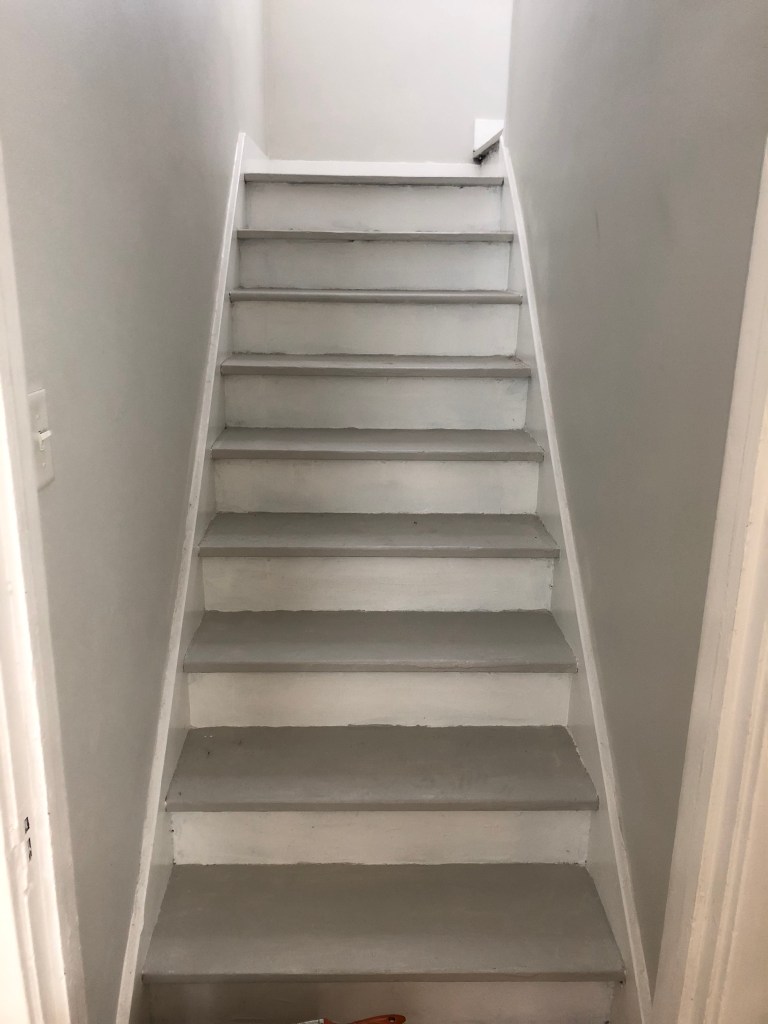
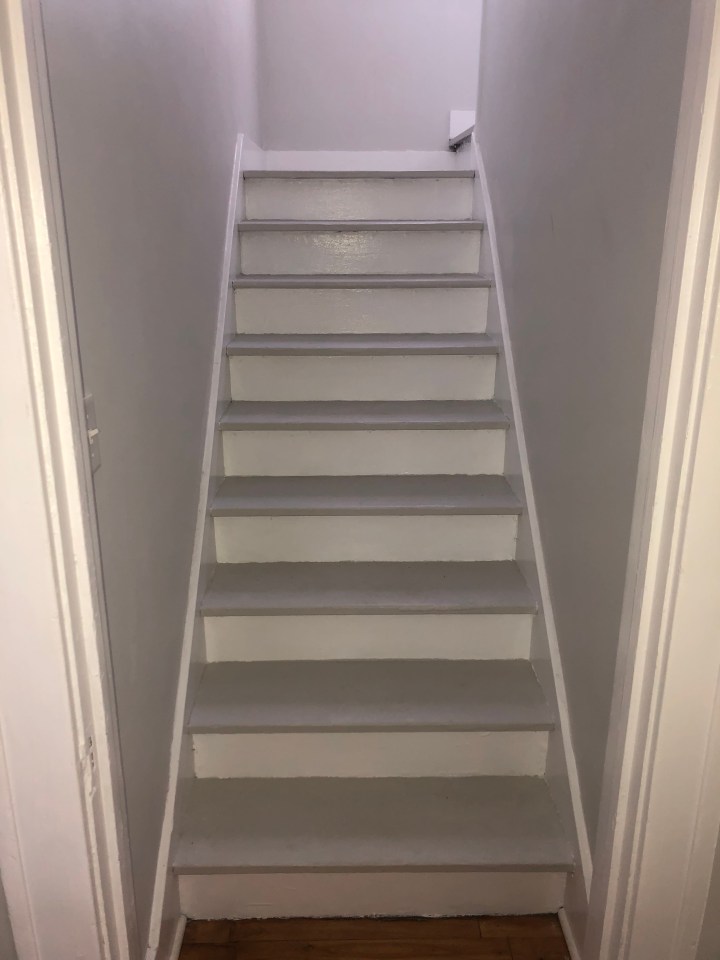
When we bought our house, we were excited about the hardwood floors throughout. We loved the beauty and warmth of the red oak wood, but there was one problem. The old owners slapped some cheap, thick, ugly paint on all of the interior stairs.

No matter how often I vacuumed and scrubbed, these stairs never looked clean. Since I didn’t want to carpet over them, replace them, or pay professionals to strip the paint, I knew I needed to get creative. I contemplated stripping them myself or even using contact paper with a thick polyurethane overcoat. Eventually I realized I should just fight fire with fire and paint over them.

I am so happy I went this route. I refreshed my stairs for about $75 and you can too!

materials needed

  • 2″ angled paintbrush
  • Paint stick and can opener
  • Caulk
  • Primer (a good multisurface primer is key. This one is tried and true.)
  • Anti-skid porch and floor paint for the step (I used Valspar Repose Gray, more on that below)
  • Riser paint (I used a pure white semi-gloss but would recommend a flat white as I don’t love the shine)

cost breakdown

ItemQuantityCost/UnitTotal Cost
Paintbrush1$6$6
Paint stick and can opener1$0$0
Caulk1$8$8
Primer1$11$11
Porch + floor paint1$40$40
Riser paint1$10$10
$75

instructions

step one: clean and prep

The first thing you want to do is make sure your stairs are clean. I scrubbed with a rag and some soapy water. The goal is to make sure you have a clean, even surface to paint.

Once the stairs were clean, I went back over them with a paintable caulk to fill in any holes or cracks. Since my home is 100 years old, there was some mild separation between the steps and the baseboard trim so I filled that with caulk. You might find you need to fill nail holes from when you pulled up the carpet, or there might just be minor dings or dents on the stairs. If necessary sand any uneven areas.

step two: prime

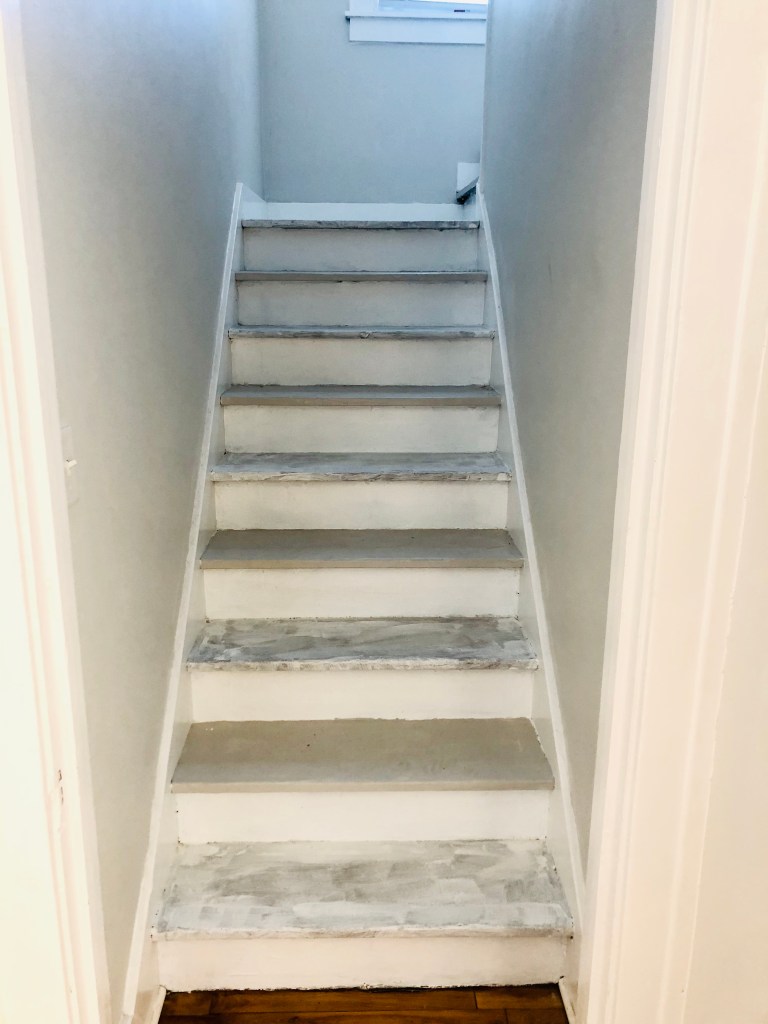
I broke this step down into two days. On day one I painted the Zinsser Bulls Eye primer on all of the risers and on every other step. You want to prime every other step so that you can still use the stairs! I let the stairs dry overnight and primed the other steps the next day.

Don’t skip the priming step as it really helps you use less paint to get an even, clean result.

Word to the wise, make sure you rinse your paintbrush right after you finish using it for the day. Dry it with a paper towel to get out the excess water, and leave it handle-side up to finish drying. This will help keep your brush clean and soft, instead of rock-hard and useless.

step three: paint the risers

I did the first coat of my white riser paint before painting any of the steps so I could be a little messy. The angle of the brush will help you get into the corners and go along the edges with minimal mess. Make sure to clean as you go by taking a rag, paper towel, or in my case my finger, and cleaning up any stray paint marks.

If you know you’re a bit messier with paint, try using an edging tool or painters’ tape to keep paint off of the walls.

step four: paint every other step

Using your preferred step paint, carefully paint your first coat onto your first step. Do you like the color? I hope so! Keep painting, but remember to paint every other step so you can still use your stairs.

Let the steps dry overnight. Then paint a second coat and allow those to dry. Now you should have painted risers and half of your steps.

step five: paint the remaining steps

Once the first round of steps are dry, you can paint the remaining steps. Repeat the process from step four. Since all of your steps are painted the same color, do something to signify which steps are dry and safe to walk on. I used my paint supplies and set one item on each step that was okay to walk on. You might consider using a piece of painters’ tape or a Post-It note.

step six: riser second coat

Finally, all of your steps are painted! Now go back and add a second coat of paint to the risers, being extra careful not to get any on your newly painted steps. A second coat lets you clean up any patchy spots or spots where you might have gotten a little messy with the step paint.

closing thoughts

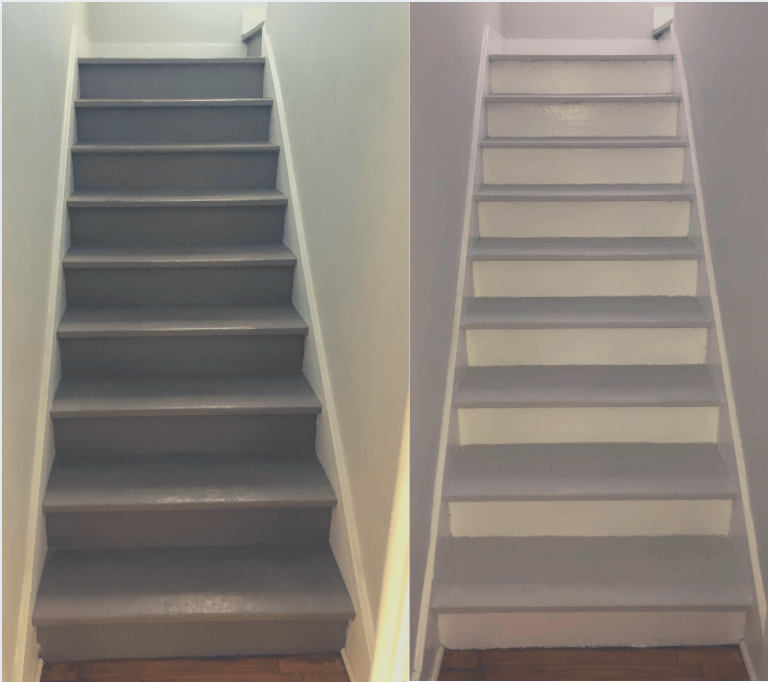
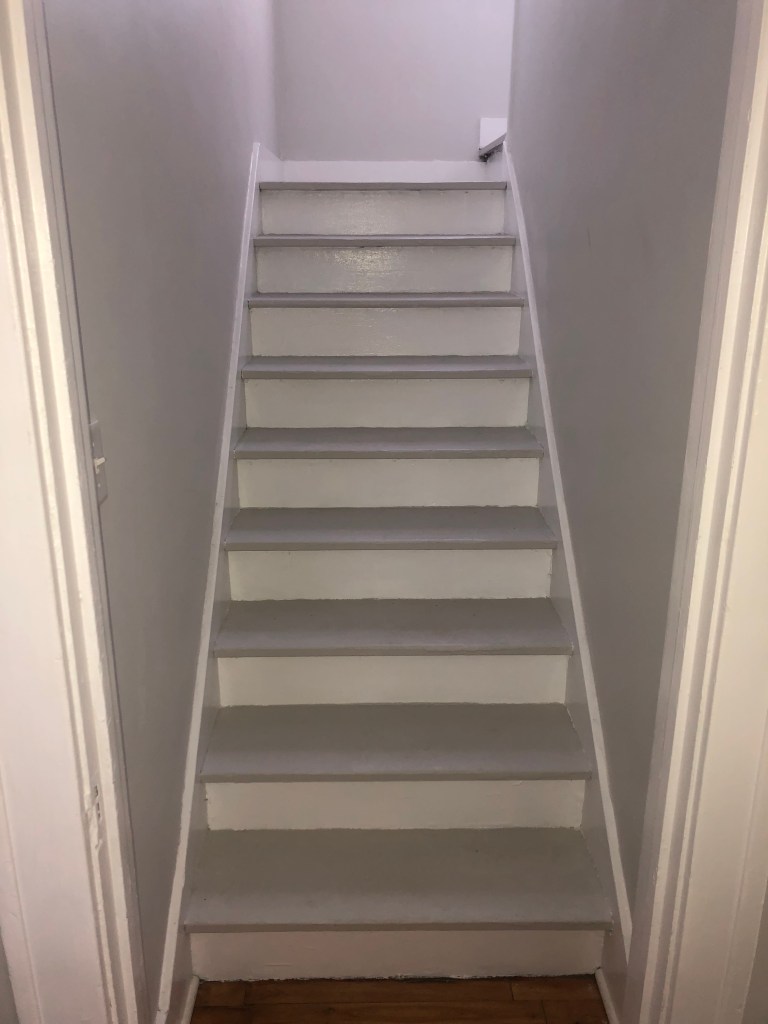
Overall, I’m thrilled with the results. The before and after pictures speak for themselves. This was a complete upgrade, and I would recommend this method to everyone looking for a quick and low cost fix.

HOWEVER, after living with newly painted stairs for a couple of months there are some things I wish I could change.

First, I used leftover trim paint for the risers. The problem is that it’s a semi-gloss and the gloss is fairly noticeable (at least to me!). If I could do it again, I’d use a flat white paint like the one linked above.

Second, I love the color of the step paint, but it’s a bit too light for the type of traffic our stairs get. We have a dog who tracks dirt inside, and I can see his paw prints and dirt smudges. I try to wipe them down regularly, but who wants to wipe their stairs down every day? I wish I’d gone with a slightly darker color that wouldn’t show dirt as much. I anticipate painting over them at some point, but for now I really do love the color and you can’t beat the cost.

If you decide to paint your stairs let me know how it goes!

everything you need to know to pass the Project Management Professional (PMP) exam

The Project Management Professional (PMP) credential is a professional certification that tells the world you know your stuff. The Project Management Institute (PMI) is the organization that issues the certification. PMP requires a rigorous application process and a challenging four (yes, four!) hour exam.

But fear not! I passed the exam the first time, and have outlined how I did it. I really wish I would have had a direct list of tips and tricks to make my exam prep feel more intentional.

You might be thinking “sure, well some people are just good at taking standardized tests.” And you’d be right. However, I am not one of those people. I simply followed the steps below and studied hard.

I don’t mean to imply that passing the PMP exam is easy, because that is not the case! In 2020 the pass rate for the PMP exam is 61%. I’m going to show you how to be part of that pass group.

what is the PMP exam?

The PMP exam comprises 200 multiple-choice questions. Only 175 of the questions are scored though. The other 25 questions are decoy or test questions. A decoy question is one that PMI uses to judge if the test has been compromised. It’s typically a harder or unrelated question, and if many people begin to get that question correct PMI knows somebody broke the code of ethics and shared the test questions. A test question is just what it sounds like; a question the PMI is considering for the next year’s test. Your answer is not counted but could be in the future.

The PMP exam is typically taken at a testing center on a computer. I’ll go into more detail about the exam setting below. Since COVID-19, PMI appears to allow people to take the exam at home via a secure portal, but I’m unsure if that will continue.

One final thing you must know before you begin studying for the exam: you must apply and be accepted as a member of PMI before you may sit for the exam. The application is no joke, so check out my post on How to Apply and Get Accepted into PMI, which will be coming soon.

Okay, now on to my study tips!

study tips

one: find the right study materials

There are endless tools available for preparing to take the PMP exam. Everybody studies differently, so take the time to research the tools and select the ones that will work for you.

Here are the must-have tools for exam success:

  • PMBOK book: this is considered the bible of PMP studying. The PMBOK guide, or Project Management Body of Knowledge, is considered the single source of truth by PMI (probably because they write it!). They are currently on their 6th Edition as I write this, but be sure to check before you buy. You’re expected to basically know everything in this book. I read through this book created notecards from the vocabulary words (you need to know the PMP definition, which is not necessarily the common definition), but didn’t refer to it after the first read-through.
  • Additional book or guide: far be it for me to speak ill of the PMP Bible, but PMBOK is a super dry read. I researched supplemental study guides and settled on Rita Mulcahy’s PMP Exam Prep. It’s a bit pricy, but it does an AMAZING job of breaking down what’s in the PMBOK, giving you exam tips and tricks to watch out for, and incorporating exercises and practice questions. I don’t think I’m overstating things to say this is the reason I passed the exam.
  • Formulas: these will be outlined in the PMBOK and  Rita Mulcahy’s PMP Exam Prep book. Make sure you know them and which processes they belong to.
  • Flashcards: if you’re like me, repetition is the key to remembering anything. I created my own flashcards, but you can opt to purchase some. Just make sure they’re the correct edition. Here are some for the 6th Edition.
  • Digital flashcards: there are some great apps that offer digital flashcards so you can study anywhere! Some popular apps are Chegg Study, Brainscape, or Quizlet. I used Quizlet to supplement my paper flashcards, but I prefer paper to digital personally. However, some apps allow you to pick from existing cards so you don’t have to make your own, but I find writing them myself is more helpful.
  • Practice exams: this one is a must. The rule of thumb is that you should be able to pass a practice exam with 80% or better before you’re ready to sit the real exam. PMI offers some sample questions on their website, but you’ll want to invest in at least one practice exam (see below).
  • PMP Handbook: PMI creates a nice handbook that offers you test details, an application timeline, exam details, and more. Be sure to give it a look before you begin your journey.

two: create a study schedule

This one is a little tricky if you don’t yet know when you’ll sit for the exam. I knew I wanted to take my time, so I began studying in early January and took the exam in March. I’ve heard of people studying for a week before sitting and passing the exam (HOW?!), but the average is about two months.

The amount of time you need to study also depends on how much time you can dedicate each week to studying. Some recommend 21 hours of studying each week (i.e. 3 hours per day), but I was working full-time while studying and primarily loaded up my weekends.

Below is my suggested study schedule. I honestly believe Rita’s book is the only textbook you need as she breaks down every single process area, formula, and knowledge area in a clean and understandable way. While you’re reading take notes and create flashcards as you go. That way you’ll have notes and flashcards to study, instead of just re-reading the chapters. Make sure you quiz yourself each week on what you learned the previous week (again, flashcards make this easy to do).

Week one: read Rita Mulcahy (RM) chapters one and two, do all activities and questions
Week two: read RM chapters three and four, do all activities and questions
Week three: read RM chapters five and six, do all activities and questions
Week four: read RM chapters seven and eight, do all activities and questions
Week five: read RM chapters nine, 10, and 11, do all activities and questions
Week six: read RM chapters 12 and 13, do all activities and questions 
Week seven: read RM chapters 14 and 15, do all activities and questions
Week eight: create dump sheet based on troubled areas and rewrite it twice, review flashcards and notes, study common traps of the PMP exam
Week nine: take practice exam one, review what you got wrong and supplement understanding with RM book or look up videos (there are tons, but try searching the keywords of what you’re struggling with along with “Belinda Goodrich” – that woman’s videos were SO helpful to me).
Week ten: take practice exam one, review what you got wrong. If you’ve passed both practice exams with at least 80%, you might not need to take another.
Week eleven: practice recreating dump sheet, review flashcards and notes
Week twelve: take a final practice exam, review what you got wrong, make sure you’re looking at videos and reading reputable online articles about areas that trouble you.
Week thirteen: take that exam and kick its butt!

Need to pass the PMP exam fast (like in 10 days or a month)? Double up on your reading each week to cut down on your overall study time. See my accelerated PMP study schedule below.

Week one: read Rita Mulcahy (RM) chapters one-five, do all activities and questions, make flashcards for these chapters
Week two: read RM chapters six-10, do all activities and questions, make flashcards for these chapters
Week three: read RM chapters 11-15, do all activities and questions, make flashcards for these chapters
Week four: create the first draft of your dump sheet, study common traps of the PMP exam, and take practice exam one, review what you got wrong. If you did not get at least 80% on this practice exam, plan to take another this week.
Week five: study flashcards each day leading up to the exam and focus on your trouble areas. Then sit the exam and kick its butt!

three: take a course

Though not 100% necessary, I did opt to take an in-person course taught by an instructor who really knows the exam content. The course was pricey but came with lecture notes, study materials, and a PMBOK. And you could ask a real person any questions you had about the exam or application process.

If you’re someone who struggles with remote learning, this might be a good choice for you. I have mixed feelings about the course I attended, and I actually think Rita’s book did more for me than the course. However, some people just learn better in a classroom setting. And there’s something to be said for having a real live human who knows what they’re doing.

four: study!

This should go without saying. 

Just in case it’s been a while since you’ve studied for something, here are some proven tips that can help you get the most out of your study sessions:

Equal spacing of study sessions is most effective according to the American Psychological Association. “It’s better to study for three hours each week for four weeks than to cram all 12 hours into week four.” See tip two above for a suggestion on how to equally space.

Testing yourself on the material is one of the only ways to ensure you’re able to accurately recall information. Testing is thought to improve your long-term memory, versus just reading and rereading the same material. Try to get someone to quiz you on the material and make sure you take at least one practice exam.

Study at your local library! I love public libraries and found that studying outside of my home allowed me to focus better. I wasn’t side-eying the dishes in the sink or trying to also do laundry at the same time. Dr. Robert Bjork, a cognitive psychologist, suggests that new scenery can help us better retain information, too! If your local library or coffee shops are not an option, try studying outside, in a friend’s home office, or even in your car (I think I studied more flashcards in my car than anywhere else).

Flashcards are your best friend when studying so much material. I had about 300 flashcards for the PMP exam. I even color-coded them. Green was for vocabulary, purple was for concepts, and red was for formulas. I would run through the cards ANYWHERE I had time (in line at the store, waiting for an oil change, at Secretary of State, etc.). I would also sort them into three piles as I went:

ONE: content I had down and could recall easily
TWO: content that I knew partly or didn’t feel confident with
THREE: content I really needed to focus on

As an old basketball coach used to say “repetition is the key to learning.” Spend time studying cards in each pile, but with an emphasis on the ones you know the least. Each time you correctly identify the flashcard, move it from the third pile to the second pile, or from the pile two to pile one until (ideally) all of your cards are in the pile. If there are items you just can’t seem to remember, make sure it’s referenced on your dump sheet (more on this below).

  • Focus on making connections versus just memorizing. Think about the concepts you’re learning and apply it to your real-world job as a project manager. When you’re reading about the steps in the closing process, think of the last project you closed out. Did you take these steps? Did you only take some of them? Can you apply these steps to your current projects? You get the idea…
  • Studying in a noisy place? Listening to classical music or acoustical covers (i.e. music without vocals) really helped me focus. Some people find it difficult to focus while music is playing and some cannot study without it. Consider vocal-free music as a happy medium. I liked to find acoustic covers of popular songs on Spotify as my background music.

five: take some practice exams

You must, must, must take at least one full-length, timed practice exam. The experts say you need to pass with at least 80% in order to pass the real exam.

There is SO MUCH CONTENT you need to know in order to pass this exam, and testing is the only way to ensure you’re retaining it. Most guide books offer practice questions that are formatted like the exam questions will be. This is great practice, but it would be worth your while to invest in a full-length practice exam.

You’ll likely have to purchase the practice exams, but you can usually purchase one for $50 – $200 or so. Try Udemy, PMP Exam Simulator, or Tests.com.

six: create a dump sheet and memorize it

What is a dump sheet?
A dump sheet is a 100% legal “cheat sheet” that you can refer to during your exam. The idea is that you take the first 3 minutes of your exam time to write down any terms, processes, formulas, etc. that you know you might have trouble remember during the exam. You memorize this dump sheet, regurgitate it right when your exam starts, and then you won’t stress about recalling this info during your exam because you’ll already have it written down!

The key to a successful dump sheet is to establish the content you feel worried about remembering and write it down on a sheet of paper. Then you replicate that dump sheet on a new piece of paper. Do this again and again until you can replicate it perfectly.

What goes on a dump sheet?
This largely depends on you and what you’re concerned about remembering. My dump sheet contained the following:

  • Each formula written out (PERT, present value, internal rate of return, estimate at completion, etc.)
  • Critical path float/no float formula
  • Seven steps of change management in order (prevent, identify, analyze, create, approve, update, communicate, manage)
  • Closing steps in order (accept, lessons, archive, close contracts, release team, close project)
  • Two types of risk: positive (share exploit, enhance) and negative (avoid, transfer, mitigate)
  • Types of conflict
  • Processes in order (by knowledge group)
  • The three quality management theorists and what they contributed (Crosby, Deming, and Jura)
  • How and when to crash or fast track a schedule

The basic idea is to capture anything you know you’ll need for the exam (such as the items above) in addition to anything you’re having trouble recalling. Once you’re able to effectively recreate your dump sheet, you’ll feel so much more confident during your exam.

seven: morning of the exam

You made it! It’s the morning of your exam. You’re probably nervous and that’s okay, you’ve worked hard to take this exam. 

I opted to take this exam in the morning because I’m by nature a morning person. And I knew I wanted to get it out of the way and not stress about it all day. There was a morning and afternoon option when I took it, but now the exam can be taken at any time on any day from your own home (more on that below).

My morning of prep suggestions:

  • Get a good night’s sleep! I know this is technically a “night before the exam” tip, but I wanted to mention is as it’s super important. There is a ton of research showing that adequate sleep is positively associated with better test scores (here’s a source if you don’t believe me.)
  • Have your clothes, bag, keys, etc. laid out and ready to go. It’s one less thing you have to think about before your exam.
  • Try not to do any more studying or reviewing right before your exam. Be confident that you’ve prepared as best you can. Cramming doesn’t tend to be effective anyway.
  • Have a nutritious, well-balanced breakfast. I thought a lot about this and decided I wanted carbs to give me long-lasting energy and protein to keep me full. I opted for a whole wheat bagel with cream cheese, lox, and capers but you might try oatmeal with some fruit, or eggs and whole wheat toast. Make sure it’s more than just coffee!
  • Do some yoga! Research has shown a link between yoga and brainpower. Try these poses before you head out for your exam, holding each for several seconds while you breath deeply to calm your nerves and stimulate your brain:
    • Downward-facing dog
    • Seated forward bend
    • Plow pose
    • Bridge pose
    • Shoulder stand

eight: familiarize yourself with the exam process

Once your application is accepted you are given a code that enables you to schedule your exam (READ HERE FOR APPLICATION). When I took the exam I was required to go to schedule in advance and go to a testing center. I’ll outline my experience below, but given that we’re living in a post-COVID world, there is currently an option to take the test online from the comfort of your own home so I’ve researched that option and outlined it for you below. 

Similarities

  • Available in 13 languages including English, Italian, French, German, Arabic, and Portuguese
  • The exam is 200 questions
  • Plan to check-in at least 15 minutes prior to your scheduled exam time
  • Previously you could take the exam straight through or take a break every 30 minutes. It was your choice. Now in both the testing centers and online you have a mandatory intermission. You can choose to take the entire time or only part of the time, but the exam is definitely divided into two parts and you won’t be allowed to go back to the first half question after the intermission.
  • You find out your results immediately after the exam, though you don’t get a score. Technically the exam is pass/fail, but they do give you a relative idea of how you did. You’ll be informed if you were Above Target, Target (both passing), Below Target, or Needs Improvement (both failing).

Testing Center

  • You will be asked to lock everything up in a locker before you’re allowed to enter the testing center
  • All I was permitted to take into the exam was the scratch paper, a pen, my ID, and the key to my locker.
  • I was asked to roll up my sleeves and pant legs so they could ensure I didn’t have anything written on my skin.

Online Test

  • In order to take the exam from your home, you need a steady internet connection and a computer with a webcam. 
  • Though the exam is not on-demand, you can schedule your test pretty much 24/7 so you can pick the time of day that works best for you 
  • While taking the exam, your webcam will be on
  • The check-in process is also online and you’ll be asked to take a headshot, show you picture ID, and show your surroundings
  • You will not be permitted to leave the proctor’s view unless it’s the scheduled 10-minute break
  • You are not permitted to stand or talk
  • You will not be permitted scratch paper, writing utensils, or a calculator
  • The exam has a built-in calculator and whiteboard (depicted below)

in closing

The PMP exam is no joke and might be the hardest exam you’ll ever take. But if you’re serious about advancing your career in the project management field, it’s paramount to go in with an understanding of what it will take to kick this exam’s butt.

If you follow my steps above, prepping for and passing the PMP exam the first time should be much easier! Just remember to stick to a study schedule with the right tools, take practice exams, and trust yourself.

You’ve got this!

how to express gratitude when you didn’t get the job

I just found out I’m not getting a promotion on my team at work. I am crushed. It’s a role I already know how to do, and I know I could bring a lot to it. But alas, I was not chosen. There are no two ways about it, this feels like a failure.

However, I do firmly believe everything happens for a reason. I’m clinging to that adage as I dust myself off and look forward. The first step is to thank my manager and the hiring team for the opportunity to interview for this position. 

It’s so important to be gracious when you’re passed over for a promotion or new role on your team. Unless you were not promoted due to illegal, discriminatory reasons in which case you should talk to your HR team (race, sexual preference, gender, age, SES, etc.). 

The LAST thing I want to do right now is thank my manager for not giving me this new role. But the professional side of me refuses to burn bridges. 

Why should you take the time to send thank-you’s for a job you didn’t get?

It shows professionalism and poise

First, it was likely a difficult decision for the hiring team. Imagine how much better they will feel knowing there are no hard feelings. That will show the hiring team that you’re professional, poised, and resiliency. This is important as it keeps you in the team’s good graces and can help you be better positioned for future opportunities.

You might not know why you didn’t get the job. A lot of times hiring managers have a very difficult time deciding between multiple candidates. You may never know the reason(s) why you didn’t get the job, but it’s helpful for everyone to trust that though you were a great fit, someone was a bit better of a fit. It just means there’s a better job or promotion out there for you.

It keeps the road clear for future opportunities

If you learn you did not get a promotion and begin a witch-hunt to discover who on the hiring team voted against you, or corner someone in the breakroom and demand to know who got the job and why it will probably feel really good. But it won’t do much else for you. Once a decision is made, it’s final. You’re not going to change anyone’s mind, so the best thing you can do is graciously accept that you didn’t get the position and immediately look forward. Showing grace at this moment in your career will position you as a team player who will be well thought of for future opportunities that arise.

It affords you another opportunity to underline your skills and desire for advancement

When you send a thank-you note, you will be able to subtly remind the hiring team why you applied for this opportunity in the first place. Leave them with a concise list of what you bring to the table. You also want to let them know that you’re ready for the next step in your career, and even though this wasn’t it for you, you’ll be watching and listening for any others that might come up. 

What next?

Step one: let yourself feel your emotions. Cry, scream, run, drink wine…do whatever you need to do. I recommend writing a journal entry (more reasons why you should consider journaling here) or calling a friend to vent. Get all of your valid but less productive feelings out. It will feel good to rage cry to your mom, but you don’t want those feelings tainting your next steps.

Step two: write a thank you note to the hiring manager or interview panel. See above for some reasons why and a free template to get you started. Do this within 24 hours of hearing you did not get the role.

Step three: contact your HR representative or department to schedule a casual conversation about the experience. The purpose of this meeting is to learn from the whole process and discuss your career path at your company. Ask for direct feedback on the interview. You want to learn if there were areas you tripped up in the interview, or if you had a skill gap you could begin working on. It should be clear that you desire a new position since you interviewed for one, but reiterate this. Have a list of your skills and accomplishments ready, and inquire about how you can continue to advance and develop.

Step four: if you truly feel ready to move on to a new role with more or different responsibilities, begin looking forward. Once you’ve connected with your HR team, you might decide that you need to look outside of your current company for a new role. My favorite job searching tools are LinkedIn, Indeed, and Glassdoor. You can set up your LinkedIn account so it sends you job listings you might be interested in, and a lot of times you can apply for new jobs with the click of a button via LinkedIn. You can also explore companies in your area to understand which share your values. Finally, Indeed can help you see what the market is for your field. You can assess average pay and get a feel for how competitive the job market is in your field. 

I know it stings to get passed over for the job or promotion you feel you deserve. But don’t let this setback hold you back. Be proactive and use this opportunity to better position yourself for future opportunities.